Introduction
Advancing in a career often means that balancing a passion for building with strategic responsibilities becomes challenging. Time shifts toward defining the “why” and the “what” for the team, leaving less room for the hands-on work that initially sparked interest in the field. Personal projects and proof-of-concepts may have to wait, all in the name of maintaining a healthy work-life balance.
Then, Generative AI tools like ChatGPT arrived and transformed the process.
With this new technology, ideas can rapidly evolve into working prototypes, often without extensive coding. It’s like gaining a teammate who understands the vision and brings it to life, enabling a focus on the big picture while preserving the joy of creation. This shift makes it possible to lead strategically and build meaningfully—combining long-developed strengths in vision with the original passion for hands-on work.
My Passion Project
Traveling together has always been a shared passion between my wife and myself, especially when it comes to finding exceptional hotels that offer something truly special. We’re both drawn to unique, well-designed places, so planning our stays involves a lot of research. To keep everything organized, we developed a spreadsheet that allows us to track all the details. Since we often work on it at different times, the spreadsheet helps us consolidate our findings, even when one of us has information the other hasn’t seen yet.
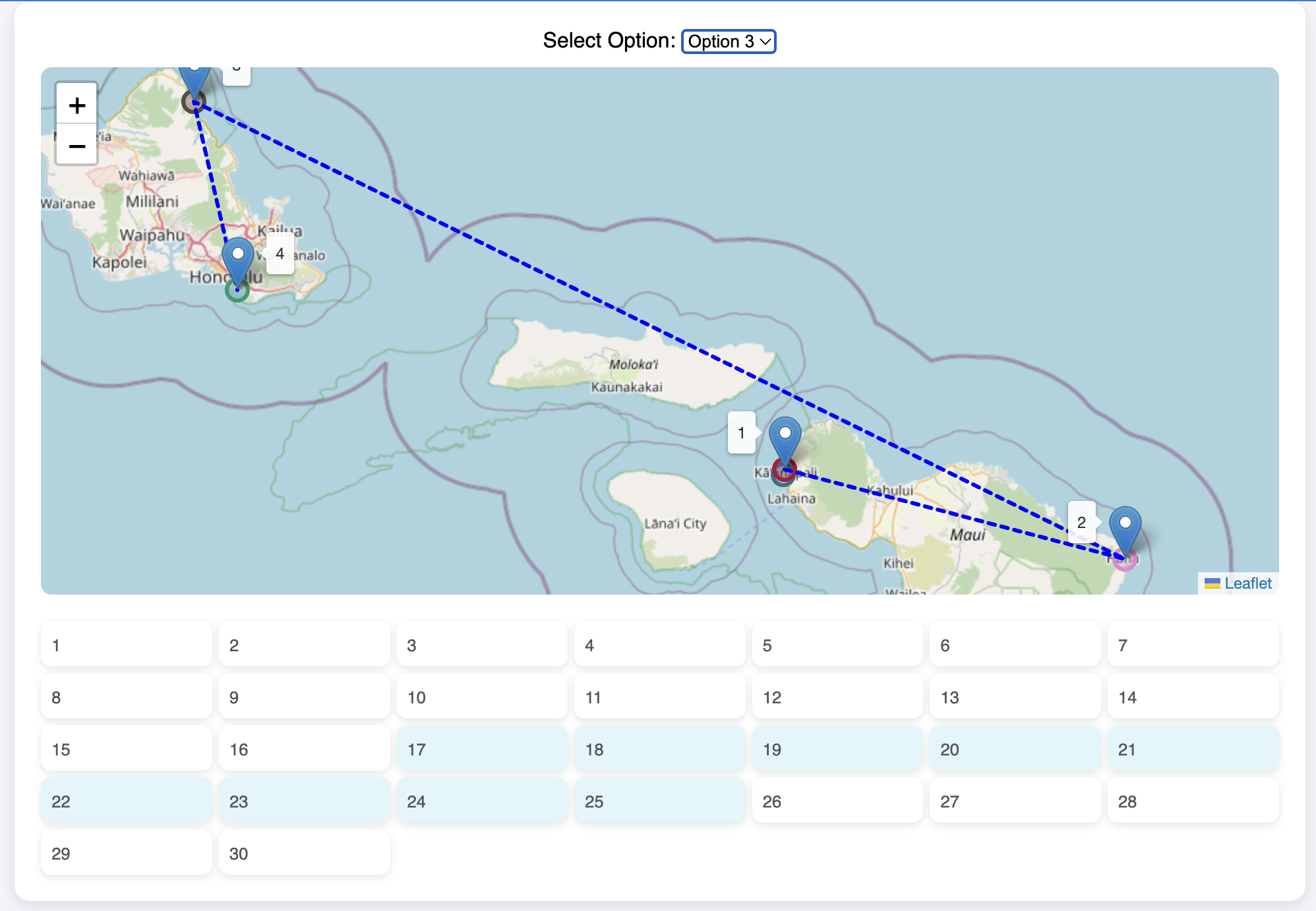
Visualizing the entire itinerary in one place is useful when sharing with other people, especially for a clear, big-picture view. This sparked the idea of transforming the spreadsheet into something more interactive—a map that could bring our plans to life. Google Maps offers custom mapping options, but creating a map for each itinerary is time-intensive and only provides location visuals. With a [prompt] creating a rich interactive experience was joyful and easy!
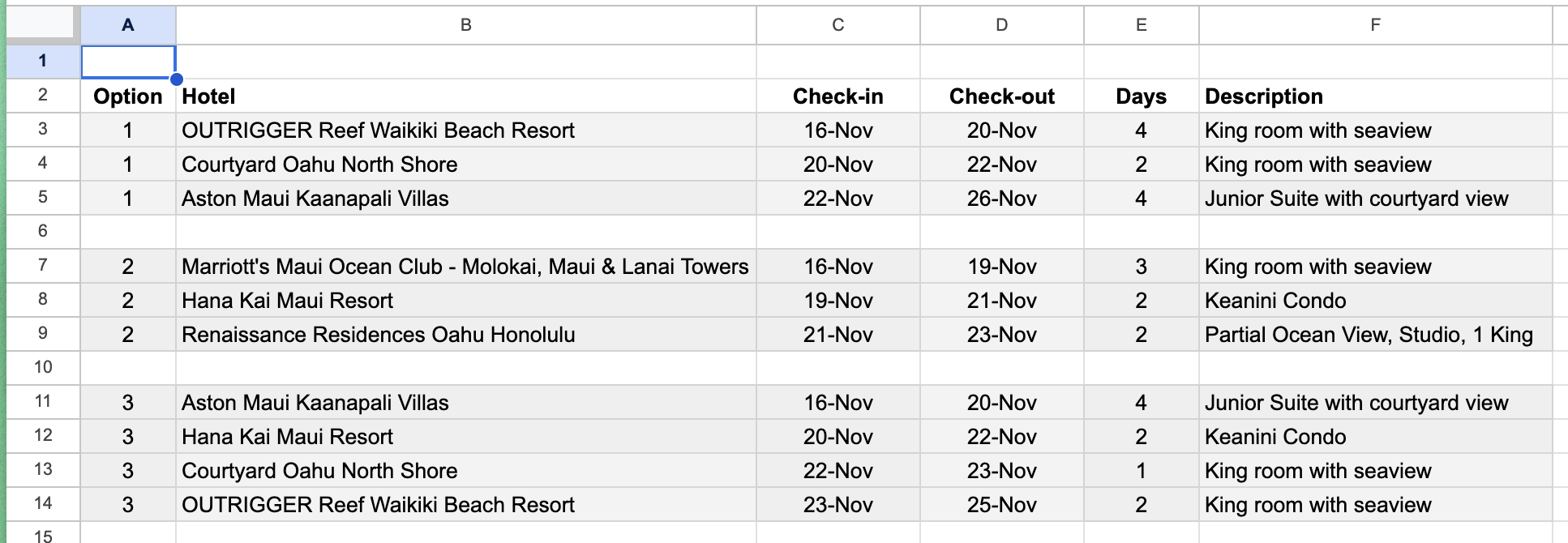

Turning to ChatGPT for help made it possible to convert the spreadsheet into a dynamic travel itinerary web page, combining both functionality and visual appeal. With just a few prompts, the spreadsheet evolved into an interactive tool that brings travel plans to life on a map. The prompt used to build the page, though simplified from a longer conversation, captures the intended outcome. Even on its own, it delivers a result that aligns with the vision behind the planning process, transforming a simple spreadsheet into an engaging map that enhances the travel experience.
At the end of the prompting session after retrying with a summary of all of my prompts the LLM did produce a similar result. This is an area where LLMs will still have some challenges, and many companies are working on miniminzing the "hallucinations" that occur. However this output is still useful and the time to produce this was essentially one screenshot of a spreadsheet and one prompt!
Augmenting my Skills
Creating a polished, functional web application usually requires a team of specialists and a considerable time investment. But with AI, the process changes entirely—bridging skill gaps and enhancing strengths, no matter where expertise lies. For instance, a great designer can use AI to handle coding, and a skilled coder can rely on AI for design. AI becomes the missing piece, augmenting skills that may be less developed while allowing individuals to focus on what they do best.
In building a travel itinerary visualizer with AI, this became clear. Traditionally, creating an app like this would require a Product Manager to set requirements, a frontend developer to build interactive elements like maps and calendars, a UI designer to make it visually appealing, and a software architect to establish a strong foundation. Each role would come with time and financial costs, with developers spending weeks coding and designers crafting layouts and color schemes to ensure a cohesive, professional result.
While tools like Tableau or Power BI could handle parts of the visualization, they lack the flexibility for creating fully interactive, user-friendly web apps. No-code platforms like Webflow or Bubble could help but would struggle with custom features, such as linking a dynamic, color-coded calendar to map markers.
AI offers a new way forward, allowing anyone to take on complex projects that once required specialized teams. With AI as a collaborator, creating sophisticated applications becomes accessible, transforming ideas into polished, functional products more quickly and efficiently than ever before.
What role did AI play?
With AI, everything changes. Instead of working on my own there is a virtual team, an AI assistant handled high-level requirements and executed across multiple roles:
Developer 👩🏻💻
ChatGPT handled all coding, using Leaflet.js to create an interactive map with color-coded markers, labels, and tooltips. The calendar was dynamically generated from data, linked to the map, and included stop numbers—all through simple requests like “add a marker” or “apply color coding.”
UI Designer 🧑🎨
Following prompts like “use a modern font” or “add subtle shadows,” ChatGPT crafted a clean, professional design with HTML and CSS. What typically takes days of design tweaks was done in minutes, with each visual adjustment applied directly.
Architect 👷♀️
ChatGPT organized the code logically, integrating JavaScript, HTML, and CSS into a modular structure. Decisions around libraries and frameworks were handled automatically, allowing complete focus on the final product.
Rubber Duck 🦆
ChatGPT also acted as a collaborative partner, my rubberduck, providing valuable suggestions that influenced the final design. For example, questions like “How can the calendar be more user-friendly?” sparked improvements that would usually come from team brainstorming.
This collaboration took less than a 25 minutes from start to finish. Instead of managing multiple handoffs or using various tools, direct iteration with ChatGPT replaced what could have been weeks of traditional development.
Reclaiming Passion Projects
Generative AI has opened a new chapter for what can be accomplished by a single person. With tools like ChatGPT, high-level ideas can be transformed into polished, interactive applications without the need for specialized teams. This technology bridges skill gaps, allowing anyone to augment their strengths and focus on the bigger picture rather than the fine details of execution.
This journey marks the beginning of leveraging AI not only to bring personal projects to life but also to create more time and space to pursue high-level outcomes. AI enables more to be achieved with less effort and energy, setting a new standard for personal productivity and innovation. The possibilities are vast, and this is just the start.
Call to Action
Ready to explore what AI can do for your own projects? Start by identifying a passion project or idea you’ve been putting off, and experiment with generative AI tools like ChatGPT to bring it to life. Whether you’re a designer, coder, or strategist, AI can help you bridge skill gaps and turn high-level concepts into real results. Dive in, start creating, and see how AI can transform your productivity and creativity!